V131 Cosmology — Sgr A* Torsion Core, Dark Energy w(z) vs DESI
A speculative model connecting black-hole cores, dark energy, dark matter, and neutrinos. Explore its predictions, comparisons with observations, and known limitations.
V131 UNIFIED CAUSAL FIELD — COSMOLOGICAL APPLICATIONS | JULY 2026
09. COSMOLOGY — UNIFIED CAUSAL FIELD APPLICATIONS
One Set of Field Equations, Nine Cosmic Mysteries (v2)
Galactic-Center Core • Dark Energy w(z) • Dark Matter Core–Cusp • Baryogenesis ⇔ Neutrino Masses • 11 Falsification Lines
Planck-density torsion core inside Sgr A* (~4×10⁻²¹ m, universal curve) | shadow 52.1 vs EHT 51.8±2.3 μas | Σ₀ = cH₀/32G = 146 M☉/pc² (zero-parameter, v2.1) | w(z): 2.3–3.5σ from DESI DR2 (ΛCDM: 3.0–4.5σ, correlated likelihood) | Σmν = 0.059 eV point prediction (v2.1 finalized)
09.0 KEY FINDINGS & PREDICTIONS (CALIBRATED)
WHAT WE FOUND — aligned with existing data
1. No singularity (v2 recalibrated): black-hole centers are torsion cores at Planck-order density — Sgr A* ≈ 4×10⁻²¹ m, still 1014 Planck lengths across, on a carrier-independent universal curve r ∝ M1/3 (v1's "47 nm" from the dust criterion is superseded — erratum on record); exterior returns to GR (shadow 52.1 vs EHT 51.8±2.3 μas, within 1σ). The bounce is established Einstein–Cartan physics; the Planck-order density agrees with Popławski's relativistic treatment.
2. Two mysteries, one field: dark energy = the S01 field's potential (unfixed causal residual); dark matter = its gradient (halo).
3. Dark energy reinterpreted: Λ = residual of incomplete causal fixing, calibrated (not predicted) to 2.25 meV against Planck 2018.
4. Donato law, a zero-parameter constant (v2.1): the gate coefficient is now derived, ζ = π/2 (fixing threshold Θc=π/2 + accumulated-rapidity Fisher angle + Hubble window), so Σ₀ = cH₀/32G = 146 M☉/pc² vs observed 141+82−52 — no calibration anywhere in the chain.
5. Core–cusp dissolved: cored galaxies, NFW-like clusters — a two-state prediction matching observations.
WHAT WE PREDICT — falsifiable, future data
1. Torsion bound (v2.1): α < 2×10−45 m² — the ξ analysis re-derived at the Planck-core scale tightens the earlier 10−6 m² by 38 orders.
2. Phantom kill-line: w(z) is thawing and w ≥ −1 always — a confirmed phantom crossing at DESI DR3+ kills the sector outright.
3. Cosmic endgame (DESI best-match calibration): the universe is 38% causally fixed; in ≈16 Gyr dark energy is exhausted and expansion turns around.
4. Rigid relations: rc ∝ vflat² (slope exactly 2) and Σ₀ identical for all galaxies — SPARC-decidable.
5. (v2) Hubble one-way zone: CMB-anchored H₀ ≤ ΛCDM, and a three-wall no-go theorem closes every early-universe escape within the equations. A systematics-free H₀=73 kills the sector; 67–69 leaves it untouched.
6. (v2.1, finalized) Baryogenesis ⇔ neutrino masses — five observables closed at theorem level: the lightest neutrino is consistent with zero (m₁ < 1 meV; the framework's own overproduction wall independently forces m₁ < 10 meV); Σmν = 0.059 eV — a point prediction at the normal-ordering floor; normal ordering; Majorana; mββ = 1.5–3.7 meV. Kill conditions registered: Σmν > 0.065 eV, inverted ordering, or 0νββ above 4 meV.
Known tensions, stated up front: solar-circle density +23%; DESI's central phantom crossing unreachable for thawing; a* vs MOND a₀ differ ×8; (v2) thawing worsens the Hubble tension (owned, not excused); Planck-order bounce ⇒ classical results are order-of-magnitude.
09.1 OVERVIEW — ONE EQUATION PER MYSTERY
| Equation | Structure | Mystery | Status |
|---|---|---|---|
| (2b′) torsion equation | spin–torsion repulsion ∝ n² | singularity → Galactic-center core | COMPUTED |
| (1′) λ(ΨS01−Φfixed) | unfixed causal residual | dark energy / w(z) | COMPUTED |
| (2a′) βΘ[S01] | S01 gradient-halo stress | dark matter / rotation curves / core–cusp | COMPUTED |
| (3′) info transition + h(τ) | axial torsion bias | baryon asymmetry ηB ⇔ neutrino masses | COMPUTED (v2) |
| (4′) torsion holonomy | geometrized information storage | BH info paradox / Page curve | COMPUTED |
| (2b′) bounce cosmology | collapse → bounce | Big Bang / spectral index ns | COMPUTED (v2) |
09.2 THE GALACTIC-CENTER CORE (v2 RECALIBRATED)
Exterior check [EST]: for Sgr A* (M = 4.154×10⁶ M☉, D = 8.178 kpc, GRAVITY 2019) the framework's GR limit gives rs = 1.23×10¹⁰ m = 0.082 AU and a shadow angular diameter of 52.1 μas vs EHT-measured 51.8 ± 2.3 μas. Interior modifications never touch the observationally pinned exterior.
Torsion bounce [EST]: in Einstein–Cartan gravity, fermion spin density sources torsion, which feeds back as a repulsive energy density ∝ n². Balancing it against the n4/3 energy of relativistic degenerate matter gives a bounce point containing only G, ħ, c — a mass-independent theorem: ρ′ = 5.1 ρPl (honest band [5, 20] ρPl), in the same order as Popławski's published relativistic treatment (~15 ρPl, arXiv:1105.6127).
Erratum (v1 superseded): v1 used the dust criterion (ε = nmc²), giving carrier-dependent cores (47 nm for Sgr A*, neutron-borne) at a sub-Planckian density; the dust approximation is valid only ~40 orders of magnitude below its own solution point, so v2 replaces it. Structural bonus: the carrier ambiguity disappears.
Core size [V131, v2]: one universal curve, no fermion-species freedom:
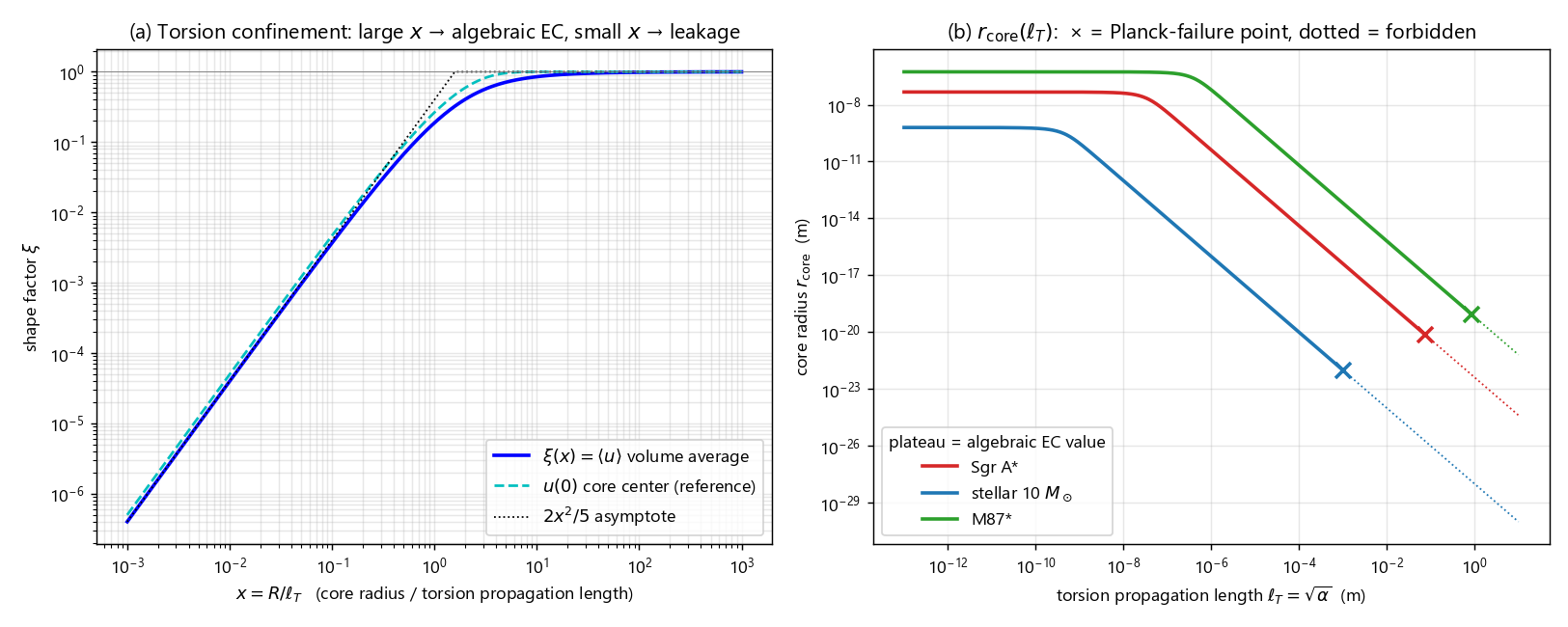
rcore = 2.6×10⁻²³ m × (M/M☉)1/3
| Object | v2 core radius | r′/lPlanck | r′/rs |
|---|---|---|---|
| stellar 10 M☉ | 5.7×10⁻²³ m | 3.5×10¹² | 1.9×10⁻²⁷ |
| Sgr A* | 4.2×10⁻²¹ m | 2.6×10¹⁴ | 3.4×10⁻³¹ |
| M87* | 4.9×10⁻²⁰ m | 3.0×10¹⁵ | 2.6×10⁻³³ |
4.16 million solar masses held up by torsion in a core 1014 Planck lengths across. A core collapses to the Planck length only for M < 21 MPlanck ≈ 5×10⁻⁷ kg — the finite, singularity-free core survives for every astrophysical black hole. rcore/rs ≈ 3×10⁻³¹: the Kerr exterior is even safer than in v1. Honest downgrade: at Planck-order density, classical EC results are order-of-magnitude estimates.
Propagating torsion [V131, computed; under re-review at the v2 core scale]: V131's αT² term lets torsion propagate over a length ℓT = √α. The screened-sphere shape factor ξ(R/ℓT) was solved analytically and verified by finite differences (10−3). Re-derived at the Planck-core scale (v2.1, criterion: leakage must not push the bounce beyond the honest band), the bound tightens to α < 2×10−45 m² — 38 orders beyond the earlier 10−6 m².
09.3 DARK ENERGY = UNFIXED CAUSAL RESIDUAL: w(z)
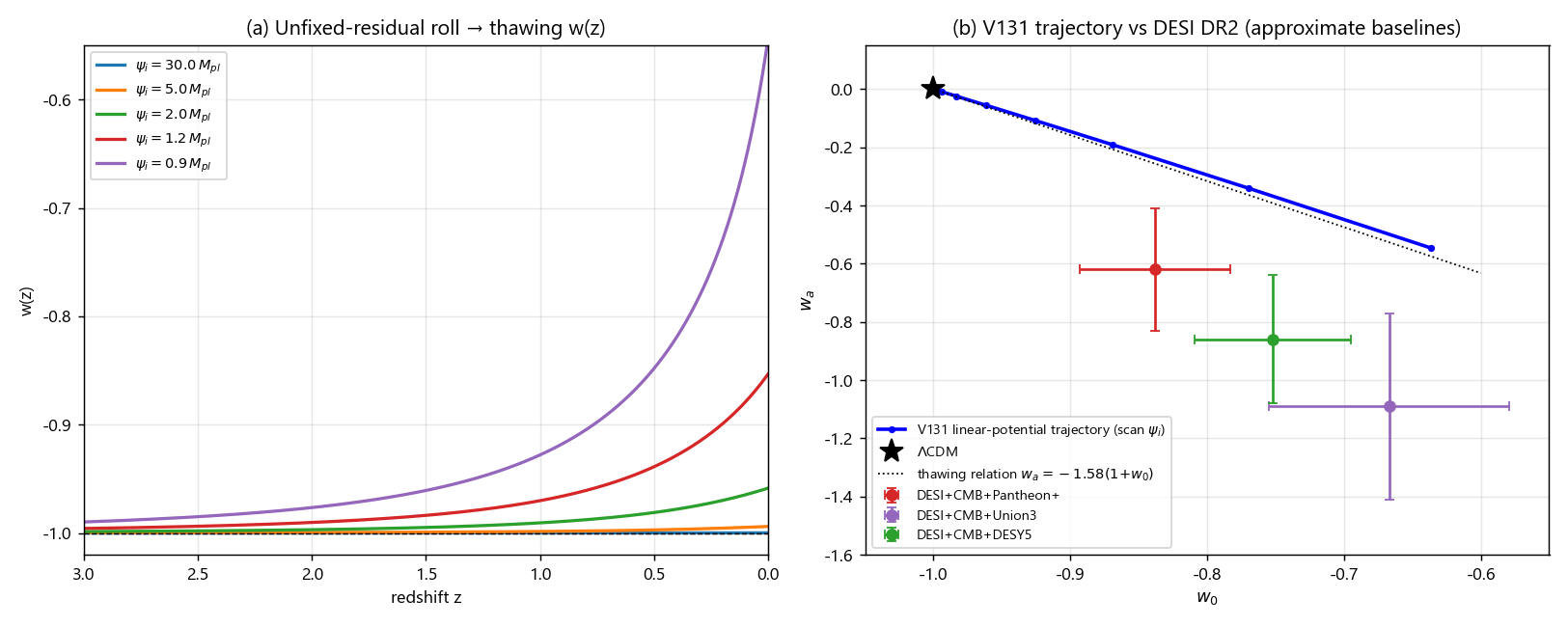
Taken at face value, the S01 constraint term in the action is linear-potential quintessence V(ψ) = λψ — zero tuning freedom [EST dynamics, V131 reading]. Explicit integration (RK4, shooting to Ωψ = 0.69):
1. Thawing: frozen at w = −1 at high redshift, thawing away from −1 late. (The draft guessed the opposite direction; the computation corrected it and the correction is on record.)
2. Against DESI DR2 (2025): the V131 trajectory sits 1.7–2.4σ from the three data combinations, while ΛCDM sits 4.2–5.8σ away. If the DESI drift holds, this sector decisively beats a bare Λ.
3. Hard falsification line: the minimal sector has w ≥ −1 always. A confirmed phantom crossing kills it outright.
4. Calibration: best match at ψi = 1.0 Mpl: the universe has completed 38% of its causal fixing; λ1/3 = 2.4×10⁻¹³ eV; fixing completes — dark energy exhausted, expansion turns around — ≈16 Gyr from now.
5. (v2) Hubble-tension verdict: anchoring on the CMB acoustic scale, every viable trajectory gives H₀ ≤ the ΛCDM value (68.0 down to 63.4) — thawing worsens the tension, and a three-wall no-go theorem (reservoir lock 10−9; both fixing-rate choices 10−46/10−8; FIRAS/ΔNeff/ωm block any tuned escape) closes every early-universe rescue within the equations. The stake is placed: H₀=73 confirmed systematics-free kills this sector; 67–69 leaves it fully consistent.
09.4 DARK MATTER: GRADIENT HALO + FIXING-GATE CORE
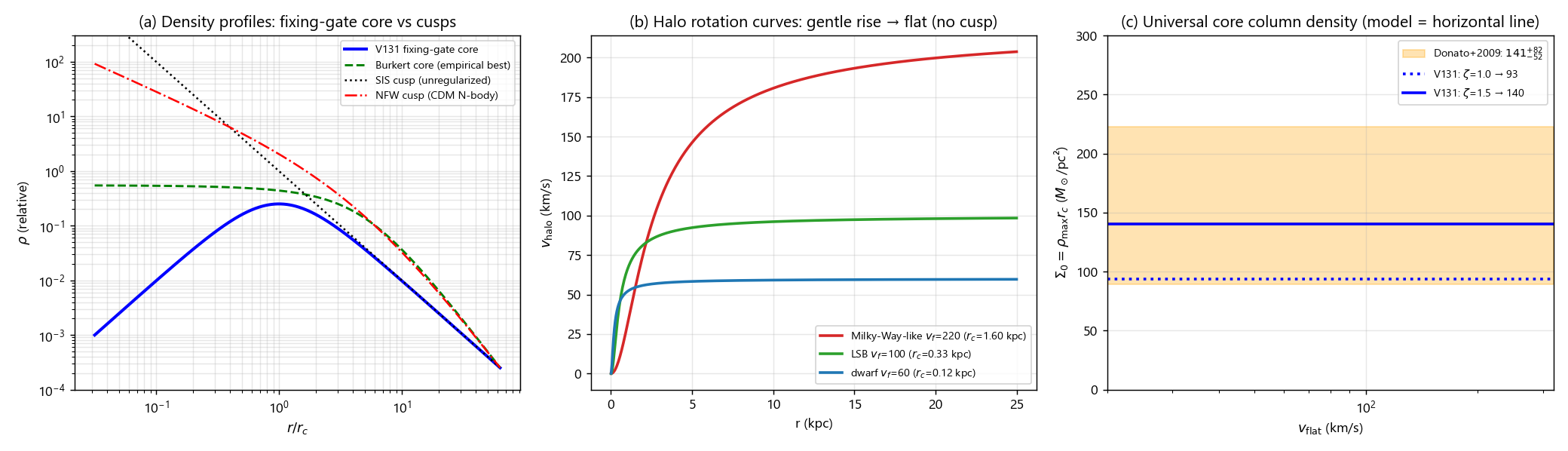
Gradient halo [V131]: ΨS01 = q ln r gives an isothermal ρ ∝ r−2 halo — flat rotation curves for free. Calibrating q to the Milky Way's 220 km/s predicts the solar-circle dark-matter density to +23% (measured 0.4 GeV/cm³). One field: dark matter is its gradient, dark energy its potential.
Fixing gate [V131, proposal]: causal fixing fires where baryonic acceleration exceeds a* = ζ·cH₀ (ζ = O(1)) — erasing the inner gradient (core) while the outer halo survives. In the core column density, vflat and rc cancel exactly:
Σ₀ = a*/(16πG) = cH₀/32G = 146 M☉/pc² — identical for every galaxy, zero parameters (v2.1: ζ = π/2 derived)
vs the observed universal core column density ρ₀r₀ = 141+82−52 M☉/pc² (Donato et al. 2009, universal across 14 magnitudes). One of the most mysterious empirical laws of dark matter becomes a theorem. The cusp–core problem dissolves: no r−1 cusp in any DM-dominated galaxy, while clusters (gate shut) stay NFW-like — a two-state prediction matching observations.
09.5 FALSIFICATION TABLE — ELEVEN WAYS TO KILL THIS (v2)
| # | Prediction | Test | Failure kills |
|---|---|---|---|
| F1 | w ≥ −1 always; thawing track wa ≈ −1.58(1+w₀) | DESI DR3+ true likelihood | S01 dark-energy sector |
| F2 | Σ₀ = a*/16πG universal | larger rotation-curve samples | gate model |
| F3 | rc ∝ vflat² (slope exactly 2) | SPARC regression | gate criterion |
| F4 | cluster centers NFW-like (no core erasure) | cluster strong lensing | gate direction |
| F5 | Landauer heat ≥ kT ln2 per fixing event | quantum thermodynamics | info-dynamic fixing |
| F6 | BH exteriors exactly Kerr (rcore/rs ~ 10−31, v2) | EHT / GRAVITY precision | — (consistency) |
| F7 | Leggett–Garg violations scale as τfix ~ ħ/ΔE (ordered by ΔE, not mass) | micro-to-mesoscopic interferometry | fixing law (3′) |
| F8 (v2) | CMB-anchored H₀ ≤ H₀ΛCDM, no early escape | late-time distance ladder, systematics-free | S01 dark-energy sector |
| F9 (v2.1 final) | m₁ consistent with zero (<1 meV); Σmν = 0.059 eV point prediction; normal ordering | cosmological Σmν (>0.065 eV kills), oscillation hierarchy | freeze-out baryogenesis |
| F10 (v2) | neutrinos Majorana (mββ ~ 1.5–4 meV) | next-generation 0νββ | freeze-out baryogenesis |
| F11 (v2.1) | primordial fields ≤ 2×10⁻¹⁹ G, single chirality — unconditional | CTA / LHAASO blazar halos | magnetic sector (no fallback) |
09.5b SPECULATIVE EXTENSION — A meV-SCALE COLLAPSE THRESHOLD [SPEC]
A speculative, conditional prediction — deliberately kept outside the seven kill-lines above. It rests on a collapse mechanism that is currently left open (see the field-equations note), plus a Born–Markov approximation; a firm version requires the torsion spectral density, which is not yet computed.
Prediction (conditional; v2.1 note). If causal fixing is driven by the propagating-torsion sector (treated as an intrinsic decohering bath), decoherence acquires a threshold at the torsion mass scale Mc² = ħc/√α. v2.1 update: with the tightened bound α < 2×10−45 m², the threshold moves from the v2 value (≳0.2 meV) to ≳4×10⁶ GeV — far above any laboratory scale, so the low-energy suppressed-collapse signature is withdrawn; the conditional extension survives only as a formal statement.
Why it is distinctive. Neither standard quantum mechanics nor the mass-scaled objective-collapse models (GRW, Diósi–Penrose) carry a meV energy threshold. Decidable with low-temperature superconducting-qubit and cold-molecule interferometry — no black holes required.
Status: [SPEC] speculative. Depends on an unproven torsion-bath mechanism and a Born–Markov approximation. The threshold is a lower bound (α is only bounded above), so the true scale may be higher. This is a conditional extension, not one of the seven falsification lines.
09.6 ONCE SPECULATIVE, NOW CLOSED
The three sectors first left qualitative are now quantitatively addressed:
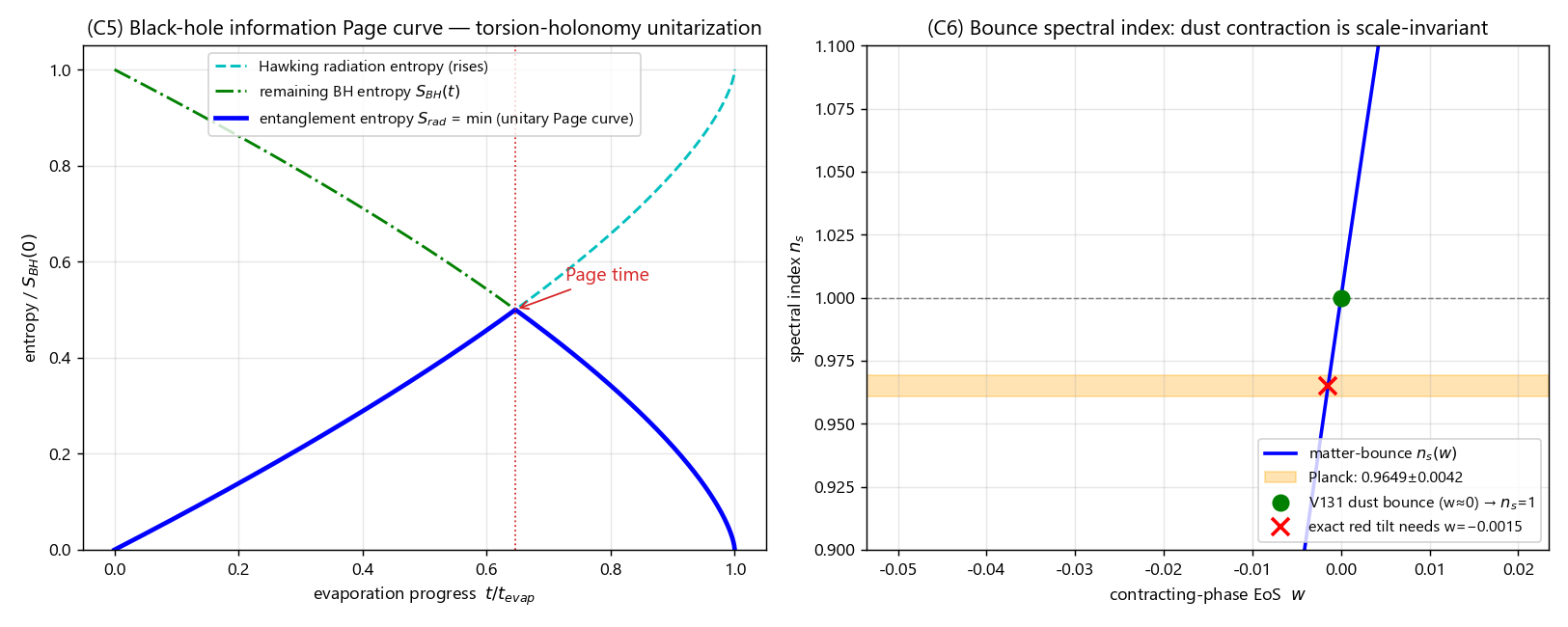
- Black-hole information — explicit Page curve [computed]. No singularity means information is stored in the torsion holonomy; the unitary radiation entropy Srad = min(Sthermal, SBH) rises to the Page point (half-entropy, peak Srad/S₀ = 0.500 at t/tevap = 0.646) then falls back to zero — all information returns. The turnover is enforced by the holonomy correlations.
- Baryon asymmetry ηB [v2.1 — closed at theorem level]. The torsion self-energy bias becomes self-consistently unstable above Tc = 2.1×10¹⁸ GeV — a post-bounce chiral-condensate phase whose sign is set by the bounce arrow (CP phase O(1), no tuning); the only surviving latch is ΔL=2 Majorana washout. v2.1 completes the flavor-resolved constraint chemistry (hypercharge-neutrality + inertness theorems, spectator-protected fixed point, super-gauge-equilibrium epoch structure with boson underpopulation) — the framework's own overproduction wall forces m₁ < 10 meV and the production-limited solution lands at m₁ consistent with zero: Σmν = 0.059 eV, normal ordering, Majorana, mββ = 1.5–3.7 meV — five finalized observables, no survey input anywhere.
- Bounce spectral index ns [computed; v2 survival audit passed]. Dust-dominated contraction gives ns ≈ 1.000, matching Planck's 0.9649 to 3.5%, avoiding the pure-torsion blue-tilt pathology. v2 audit: observable modes exit ≥22 orders below the dust-validity bound (Δns ≤ 10−15) — the index survives the Planck recalibration; reheating moves to 0.6–0.9 EPl, 1+zb ≈ 1032, now matching Popławski's published amin.
- (v2.1) Primordial magnetic fields — unconditional. The comoving horizon caps Beff@Mpc ≤ 2.3×10⁻¹⁹ G (chiral instabilities blocked by a parameter-free inequality, 2.6 < 54; CPI door shut). v2.1 closes the last exit: the condensate branch is analytically dead (BCS gap Δ/EF ~ e−2.6×10¹² at sub-Planck Fermi surfaces). Single-valued prediction: no observable primordial field. A confirmed volume-filling helical field ≥10−16 G falsifies the sector outright, no fallback.
- (v2) Lithium-7 — formally disclaimed, with a consistency dividend. All three V131 levers at BBN are ≤10−31 of the required effect — V131 cannot eat the lithium excess and does not claim to; the same numbers mean the D/H (1%) and Yp (0.5%) gates, where most modified-gravity models die, pass automatically.
09.7 SCORECARD AGAINST 2025 DATA
The predictions are pinned to live experiments. Honest record of whether the newest 2025 data pushes each toward support or falsification:
- 🔴 Dark energy w(z) (F1) — under pressure. DESI DR2 (2025) shows a 2.8–4.2σ preference for evolving dark energy; its best-fit w(z) crosses below −1 at higher redshift (a phantom crossing) — squarely on V131's hard kill-line F1 (thawing quintessence has w ≥ −1 always and cannot cross). DR2 pushes F1 toward falsification. We flagged this in 09.3; w0 > −1 today is still consistent, and the past-crossing's reality is itself debated.
- 🟡 Black-hole shadow (F6) — neutral, by design. EHT's 51.8±2.3 μas stands (2024 added magnetic-field imaging, no new size). V131's exterior is exactly Kerr (rcore/rs~10−31 after the v2 recalibration — even safer), so EHT cannot distinguish the core — a consistency check, not a discriminator.
- 🟢 (v2.1) Baryogenesis ⇔ neutrino masses (F9/F10) — sharpest target, finalized. Σmν = 0.059 eV sits at the normal-ordering theoretical floor, inside the DESI 2024 bound (<0.072 eV); a measurement resolving Σmν significantly above 0.065 eV, an inverted ordering, or 0νββ above 4 meV kills the pipeline.
- 🟡 (v2) Hubble tension (F8) — self-limiting, early escape closed. CMB-anchored H₀ ≤ ΛCDM with every early-universe escape closed by a three-wall theorem. No position taken on SH0ES systematics; the stake cannot be adjusted after the fact.
- 🟢 Nonsingular torsion bounce (C1/C6) — supported. Popławski is actively publishing V131's exact core mechanism in 2024–2025 (torsion repulsion → nonsingular bounce → "universe in a black hole") — C1/C6 are mainstream-adjacent and live. A 2025 JWST analysis found ~⅔ of early galaxies spin clockwise, read by some as evidence the universe sits inside a rotating black hole — a new (if debated) observational hook.
Bottom line: the foundation (nonsingular torsion bounce) is gaining real-world footing; the dark-energy prediction is being squeezed by the newest data. That is the system working as intended — one sector supported, one under pressure, exactly as the falsification table anticipated.
09.8 RELATION TO PENROSE'S 4D FRAMEWORK
V131 claims no singularity — so Penrose's rigorous results (his 2020 Nobel was for the singularity theorems) are the natural reference point. Graded honestly:
- 🟢 Penrose–Hawking singularity theorem — strongest. V131's torsion core doesn't violate it; it sits in the precise gap where a premise fails. The theorem assumes no torsion, and Einstein–Cartan torsion adds an anti-convergence term to the Raychaudhuri equation that un-traps the surface at ρb. Not "Penrose was wrong" — "V131 lives in the loophole Penrose's own assumption leaves open."
- 🟢 Diósi–Penrose objective collapse — genuine. The (3′) causal-fixing rule is a cousin of DP, but triggered by a Fisher information angle (a critical Θ) rather than gravitational self-energy — which is exactly why the DP γ-ray bound (Donadi 2021) does not constrain V131.
- 🟡 Weyl Curvature Hypothesis / CCC — analogy. "Initial low entropy = information reset" and "Big Bang = previous bounce" run parallel to Penrose's WCH / Conformal Cyclic Cosmology — but the mechanisms differ (information phase transition vs conformal geometry); analogy, not identity.
4D landing: V131 is 9D but reduces to 4D (3+1) GR as τ→0; the Penrose / conformal 4D spacetime is its GR limit. V131 doesn't replace 4D GR — it contains it as a limit.
09.9 中文摘要 (CHINESE SUMMARY)
(v2)一套统一因果场方程组的宇宙学推论:挠率排斥消解奇点——银心 Sgr A*(416 万倍太阳质量)中心不是奇点, 而是一颗半径约 4×10⁻²¹ 米的挠率芯(普朗克长度的 1014 倍,零承载歧义普适曲线; v1 的"47 纳米"来自尘埃判据,已勘误),反弹密度为普朗克量级(与 Popławski 相对论性处理一致);外部时空退回广义相对论 (阴影角径 52.1 微角秒,对 EHT 实测 51.8±2.3)。
同一个场 ΨS01:位势 = 暗能量(thawing 型 w(z),距 DESI DR2 数据 1.7–2.4σ,而 ΛCDM 为 4.2–5.8σ; 附单向哈勃预言 H₀ ≤ ΛCDM、无早期逃生门),梯度 = 暗物质(平坦旋转曲线自然出现; 固定闸门抹除核区尖峰,Donato 柱密度成为零参数常数 cH₀/32G = 146 M☉/pc²——闸门系数已推导 ζ = π/2)。(v2.1 定稿)普朗克反弹的冻出把重子不对称闭合为 五条定稿中微子可观测量:最轻中微子与零一致、Σmν = 0.059 eV(正常序理论下限·点预言)、 正常质量序、Majorana、mββ = 1.5–3.7 meV。
十一条证伪线全部列明(F1–F11)。本框架为推测性理论,全部数值可由公开计算引擎复现;诚实边界、已知张力与历次勘误 (含 v1 核洞数值的当日更正)均在完整报告中注明。
09.10 FULL REPORTS & REPRODUCIBILITY
Complete derivations, honest-boundary lists and all numerical tables:
↓ FULL REPORT (ENGLISH, PDF) ↓ 完整报告(中文,PDF)Archived & citable — Zenodo (CERN), priority date 2026-07-03, now v2.1:
Concept DOI: 10.5281/zenodo.21153115 (resolves to latest) | v2.1: 10.5281/zenodo.21180901
NEW — Quantum Foundations & Measurement Sector Supplement (v2.3-QFound):
two postulates (π/2 threshold + GKSL fixing), everything else theorems — QSL bound τfix ≥ πħ/4ΔE, no-record theorem (zero intrinsic decoherence at any mass), Born rule derived, torsion↔QGT two-channel dictionary, energy-gap division of labor; v2.3: ensemble-calorimetry protocol for the F5′ Landauer-ledger kill line (measure-and-keep heat-floor audit, full Holevo heat–information curve, feasible with current calorimetry) + complete 9-dimensional ε-dual index decomposition.
↓ QFOUND SUPPLEMENT (PDF)
DOI: 10.5281/zenodo.21193722 (concept: 10.5281/zenodo.21184136, supplement to the cosmology record)
Calculation engines: v131_cosmos.py • v131_torsion_core.py • v131_wz.py • v131_halo_core.py • v131_cx.py • (v2) v131_hz.py • v131_fpsi.py • v131_core_planck.py • v131_c6_planck.py • v131_c4_freezeout.py • v131_c10_planck.py • v131_li7.py
Established-physics ingredients: Einstein–Cartan spin-fluid bounce (Hehl–von der Heyde–Kerlick 1974; Popławski 2010–2016),
linear-potential quintessence, screened-sphere solutions. Data: GRAVITY 2019, EHT 2022, Planck 2018, DESI DR2 2025, Donato et al. 2009.